 English

sit at the intersection of practical research and the slower work of family history. Understanding how 7 immigration records that will completely change your family tree fit together gives researchers a clearer way to explore questions about earlier generations. The sections that follow walk through what each one offers and how they complement other approaches to family-history research.

Key Takeaways
- Immigration records like passenger lists and naturalization papers are essential for tracing ancestors who moved between countries, providing details like original hometowns, travel companions, and physical descriptions.
- Different types of records were created at various stages of the immigration process, from leaving the home country to becoming a citizen in the new one.
- While many historical records are available online through genealogy platforms, others may require contacting specific archives or government agencies.
- Details found in these documents can solve long-standing family mysteries and add significant depth to your understanding of your heritage.
1. Passenger Arrival Lists (Ship Manifests)
These lists were created by shipping companies and submitted to officials at the port of arrival, serving as the official record of entry. For much of U.S. history, these documents have been a cornerstone of immigration tracking. The evolution of these documents mirrors the changing attitudes toward immigration and the increasing role of government regulation.
What You Can Discover
Early lists from the 19th century were often simple, sometimes only naming the head of a household and the number of people in their party. However, as immigration became more regulated, the required information grew exponentially. An act of Congress in 1893 significantly expanded the details required. By the early 20th century, a manifest could include a passenger's full name, age, occupation, marital status, last permanent residence, and final destination. The most valuable columns often include "the name and address of the nearest relative or friend in country whence alien came" and "whether going to join a relative or friend; and if so, what relative or friend, and his name and complete address." This information provides a direct link to the family left behind, which is often the essential clue needed to continue research overseas.
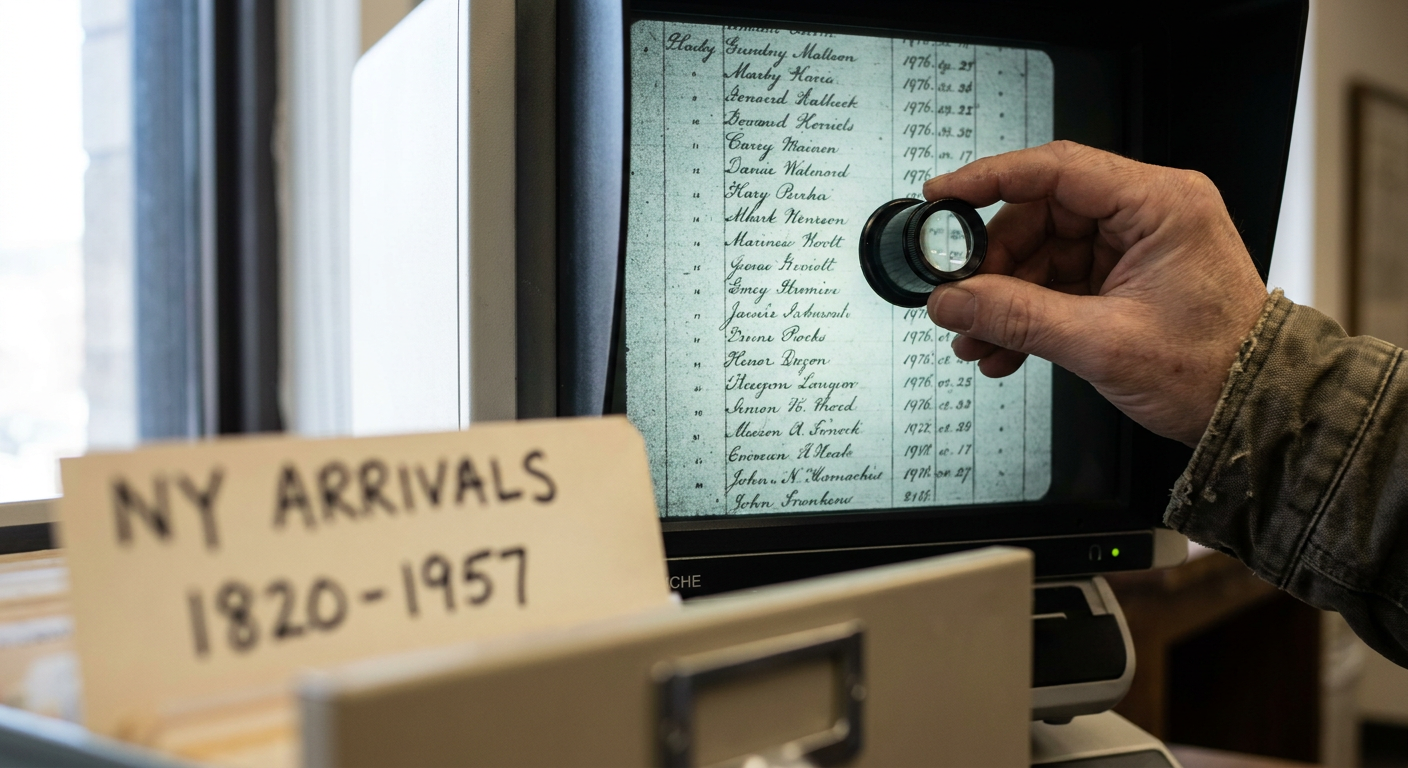
For instance, comprehensive indexes exist for millions of passengers who arrived at New York from foreign ports between 1820 and 1957. These details paint a vivid picture of the person stepping off the boat.
2. Naturalization Records
Naturalization is the legal process by which an immigrant becomes a citizen, and the paperwork it generated is a goldmine for genealogists. The records typically come in three main parts: the Declaration of Intention ("first papers"), the Petition for Naturalization ("second papers"), and the final Certificate of Citizenship. This process could take years, and the records offer different information at each stage.
Why Post-1906 Records Are Crucial
Before the 20th century, naturalization could be done in any local, state, or federal court, leading to inconsistent records that are often difficult to locate. The Basic Naturalization Act of 1906 standardized the process through the Bureau of Immigration and Naturalization, requiring significantly more information on all forms. A post-1906 Petition for Naturalization can include the applicant's full name, residence, occupation, date and place of birth, nationality, the port and date of arrival, and the name of the ship they sailed on. Crucially, it also required the names, birthdates, and birthplaces of their spouse and all children. This single document can sometimes provide the vital details for an entire family unit, including maiden names and children who may not appear in other records. The declaration and petition often provide the exact court, date, and ship information needed to find other corresponding records.
3. Alien Registration Forms
At various times, governments have required non-citizens to register with authorities, creating unique and valuable record sets.
A Detailed Snapshot in Time
These forms are a genealogical treasure because they capture a detailed snapshot of an immigrant's life at a specific moment. An AR-2 form includes the person's name and address, their date and place of birth, the exact date and port of their entry into the country, their occupation, and a physical description. It also details their arrival method, the name of the vessel, the date of their last arrival, and how long they intended to stay in the United States. For researchers struggling to locate an arrival record due to a common name or unknown travel date, an alien registration form can provide the precise details needed to find the correct ship manifest.
4. Immigrant Files (A-Files)
For researchers tracing 20th-century immigrants, a key resource is the Immigrant File, or "A-File." The United States Citizenship and Immigration Services (USCIS) began using these comprehensive case files for all immigration and naturalization matters starting on April 1, 1944. Instead of being scattered across agencies, all of an individual’s records were consolidated into a single folder, creating a rich biographical and administrative history.
A Comprehensive Life History
An A-File can be the ultimate prize. It may contain official correspondence, rare photographs, affidavits from family members, original vital records from the home country, records of every border crossing, and applications for various benefits. Because these files were compiled over a person's entire life after immigration, they offer a uniquely complete view of their journey. Due to privacy laws, A-Files are generally only accessible through a request to the USCIS Genealogy Program if the immigrant was born over 100 years ago or is confirmed to be deceased. Obtaining one can be a lengthy process, but the payoff in information is often unparalleled.
5. Passport Applications
While we associate passports with leaving a country, passport applications are incredibly useful for researching an immigrant's life after arrival. If a naturalized citizen planned to travel internationally, perhaps to visit relatives in the old country, they would have needed to apply for a passport from their new home nation. These documents serve as a powerful testament to the fact that immigration was not always a one-way street; many people maintained connections to their homeland.
Uncovering Photos and Origins
These applications can contain surprisingly rich details. In the United States, early 20th-century passport applications often required the applicant to state their date and place of birth, the date of their immigration, the ship they traveled on, and their naturalization information. They often had to provide the court and date of their own naturalization and, if applicable, their father's. Crucially, many applications from this period also include a photograph of the applicant, which might be the only surviving image of that ancestor. It serves as powerful confirmation of their identity and personal history.
6. Emigration Records (Departure Lists)
Many European nations, especially port countries like Germany, the United Kingdom, and the Netherlands, kept detailed records of people leaving their shores. These are known as emigration lists or departure lists, and they are essential for tracing a family back to a specific town.
Finding the Point of Origin
These records are vital for pinpointing an ancestor's place of origin when other documents fail. For example, the famous Hamburg Emigration Lists document millions of Europeans who departed for the Americas between the 1850s and the 1930s. These lists often name the emigrant's last town or village of residence. Similarly, the port of Antwerp in Belgium was another major departure point. Finding an ancestor in a departure list can confirm their hometown when an arrival manifest is illegible or provides only a general country of origin, like "Germany" or "Austria." This is often the final puzzle piece needed to bridge the Atlantic.
7. Ethnic Church and Community Records
When immigrants arrived in a new land, they often settled in communities with people who shared their language and culture. These communities frequently established their own churches, benevolent societies, and newspapers, which became centers of social life. The records kept by these organizations can be invaluable substitutes when official civil or immigration records are missing or lack detail.
Records from the Community
Baptismal, marriage, and burial records from an ethnic church can list an ancestor's specific town or village of origin, parents' names, and maiden names. Because the priests or ministers often spoke the same language, they recorded names and places with greater accuracy than a government clerk might have. These community-based records provide not only vital statistics but also a rich context for your ancestor's new life, showing who their neighbors were, who witnessed their marriages, and who served as godparents to their children. These clues can reveal extended family networks and community ties that official records overlook.
Putting It All Together: A Case Study Approach
No single record tells the whole story. The real breakthroughs happen when you combine information from multiple documents to create a cohesive timeline. Imagine a researcher starts with a name and an approximate birth year for their Italian great-grandfather.
- Start with the Census: A census records document might list the great-grandfather's immigration year and state that he was "Na" (Naturalized). This provides a target date for searching other records.
- Find the Naturalization Papers: Using the census information, the researcher finds his Petition for Naturalization from 1925. This document names the ship ("SS Colombo" and the arrival date (May 10, 1920, at the Port of New York). It also names his wife and children and, most importantly, his exact village of birth in Italy.
- Locate the Ship Manifest: With the ship name and arrival date, finding the passenger manifest is straightforward. The manifest confirms his village of birth and adds a crucial new detail: the name and address of his father, still living in Italy. It also lists that he was joining his brother who already lived in Chicago, providing another avenue for research.
- Connect to Italian Records: Now, with the exact town name, the researcher can search historical records and find the great-grandfather's original birth certificate, his parents' marriage record, and the births of his siblings.
By following the trail from one document to the next, a researcher can move from a simple name to a multi-generational family story spanning two continents. Each record provides clues that unlock the next, demonstrating how these seemingly dry documents work together to reconstruct a life.
Tracing your family’s immigration story is a challenging but deeply rewarding part of genealogy. Each document uncovered adds another layer to their history, revealing the path they took and the life they built. The journey to find these records can be as profound as the journey they once made.
Frequently Asked Questions
