English
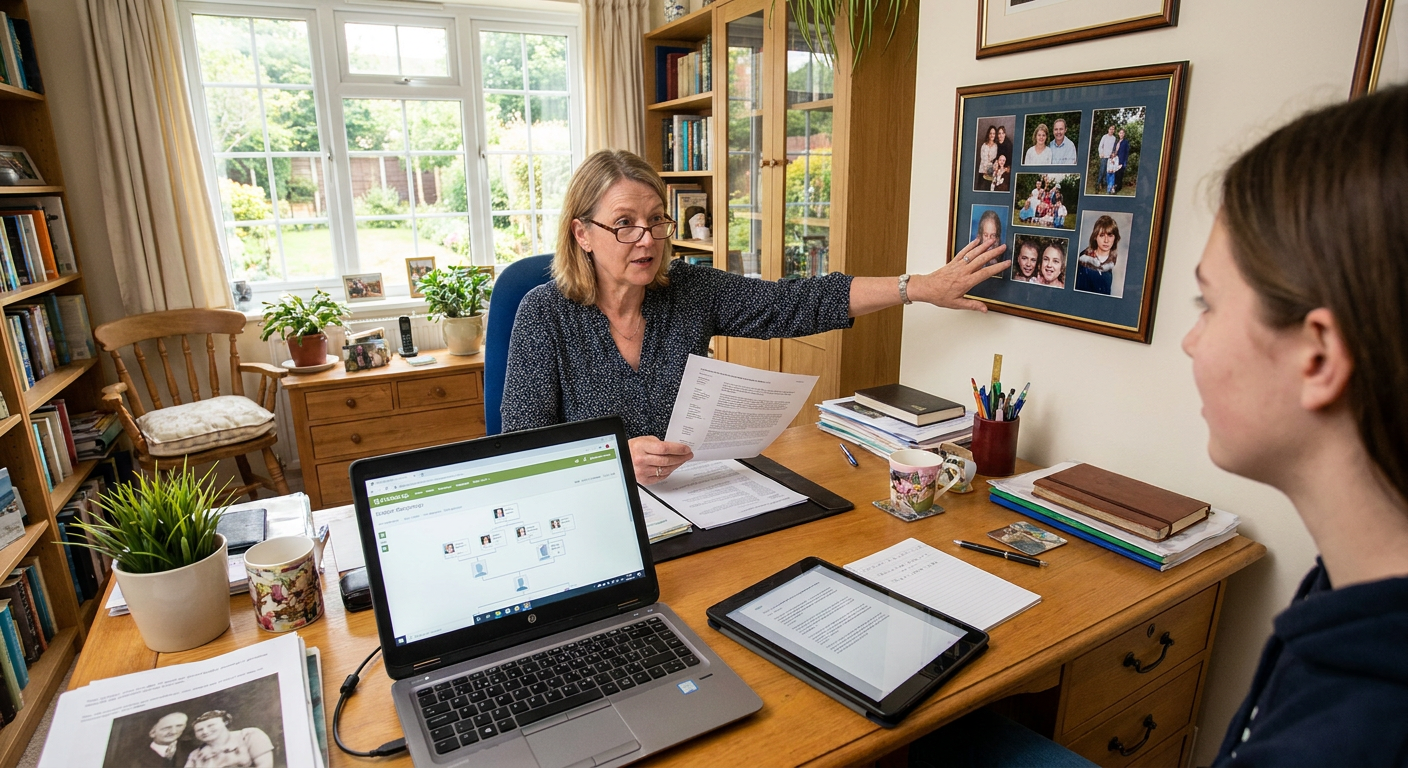
Attaching genetic data directly to an ancestral pedigree transforms raw biological markers into meaningful family relationships. Without an attached lineage, test findings show percentages and lists of shared genetic material without clarifying which branch of a family tree accounts for those connections. Linking your genetic profile to a pedigree places each shared segment into historical context, allowing automated discovery features to pinpoint common ancestors across multiple generations.

Key Takeaways
- Attaching a test to a pedigree establishes a home person, anchoring all biological relationships to a specific individual on the chart.
- Pedigree connections enable advanced genealogical features like automated family relativity theories and shared ancestor hints.
- Linking genetic matches to individual ancestor profiles confirms paper trails across maternal and paternal lines.
- Maintaining separate profile assignments ensures that managing multiple family tests does not mix lineages.
- Combining genetic facts with historical documentation creates permanent, verifiable evidence for complex kinship claims.
1. Establish the Home Person on Your Lineage Chart
Designating the primary subject of a genetic test as the root individual on a pedigree chart forms the foundation of all subsequent genealogical analysis. When a test kit remains unassigned, genealogical algorithms cannot determine whether a match originates from the maternal or paternal branch of the family.
Setting the home person anchors the biological dataset to a specific branch on the chart. In account settings under genealogy and family tree management, selecting the appropriate profile connects the genetic dataset directly to that individual's pedigree entry. This step tells the system who provided the biological sample, providing the starting point from which all cousin relationships, ancestral paths, and pedigree charts are calculated.
Assigning the home person eliminates confusion between generations. For instance, if an administrator manages an account representing three generations, designating the exact tester prevents generational skews where parent and child results might otherwise display identical kinship distances. The home person serves as coordinate zero for all subsequent centimorgans evaluations, segment triangulation, and relationship predictions. When an account lacks this anchor, shared match utilities cannot calculate whether a detected cousin represents a first cousin once removed or a second cousin, because the software cannot calculate generational elevation without an identified root individual.

2. Connect Your Raw Genetic Profile to a Specific Tree
Building or importing a pedigree chart is necessary before any link can be finalized. Many family historians choose to create an initial pedigree directly on a research platform or upload an existing chart file to their account.
Once a lineage chart exists within the account, navigation settings allow the researcher to select the exact tree that pairs with the genetic data. From the test summary settings, scrolling to the family tree linking section allows one to choose the specific pedigree to attach to the genetic results. When managing multiple trees, such as one focused on a spouse's family and another on direct maternal lineages, selecting the correct lineage prevents common ancestors from miscalculating.
Confirming this association activates automatic scanning across matching databases, which compares common surnames and locations across shared family lines. Researchers can edit or change the selected tree at any time as their documentation grows and branches expand. A researcher who begins with a basic four-generation chart can later swap the association to a larger, thoroughly verified master lineage without losing historical match data or recalculating existing chromosome coordinates.
3. Manage Multiple Kits by Assigning Each Sample to the Correct Relative
Family historians frequently manage genetic kits for parents, grandparents, aunts, or cousins to isolate specific ancestral lines. If every kit remains attached only to the account owner, cousin comparisons lose their targeted value.
Each uploaded or tested sample must be associated with the specific individual who provided the biological sample. Within test management settings, selecting the option to assign a kit to another individual allows the administrator to choose the relative's name directly from the pedigree chart. This distinction ensures that an uncle's test reflects his exact position on the pedigree, isolating shared centimorgans along the maternal grandfather and grandmother lines.
Separating multiple kits into their proper branches prevents administrative errors. When distant cousins review their shared matches, seeing an uncle correctly placed as the tester clarifies the exact degree of kinship, distinguishing full siblings from half-siblings and avoiding misattributed generational lines. Proper assignment also prevents false assumptions when navigating phased results, ensuring that matches inherited through paternal lines do not show up as maternal matches to outside relatives reviewing your pedigree.
4. Leverage Automated Matching and Family Relativity Systems
Connecting a genetic dataset to a pedigree chart unlocks automated relationship identification. Features such as Theory of Family Relativity™ examine family trees and historical records to construct plausible bridge paths between genetic matches.
These automated systems analyze genealogical profiles and historical records to suggest how two individuals connect across generations. When both testers have linked pedigrees, the system can automatically identify the shared ancestral couple, saving months of manual chart comparison. The broader network of historical records provides the documentation needed to prove each generational jump proposed by the algorithm.
This integration helps trace complex lineages, such as identifying branches that emigrated from Eastern Europe or regions like Romania, where parish registers and civil documents require precise geographic anchors.

5. Pair Shared Matches Directly with Ancestor Profiles on the Pedigree
Identifying a shared genetic match represents only the first phase of genetic genealogy. The next step involves attaching that match directly to their verified place on your pedigree chart once a relationship is confirmed.
Linking matches on the tree associates the genetic profile of a known cousin with their specific profile card. Documenting these connections creates a verified genetic map, marking which branches of the family possess biological confirmation. Over time, as more second, third, and fourth cousins are attached to the tree, entire ancestral lines become verified through overlapping segments of shared DNA.
This matching process transforms hypothetical family trees into scientifically supported pedigrees. When multiple distant cousins match the same ancestral branch and align with identical chromosome segments, the documentary evidence linking those generations achieves biological corroboration. If three descendants of a common great-great-grandfather share a distinctive 24 cM segment on chromosome 7, linking all three individuals to their corresponding pedigree cards proves that the documentary lineage reflects biological descent.
6. Document Genetic Evidence and Fact Sources in Pedigree Records
Accurate family history requires linking genetic evidence alongside historical records.
Genealogical software and digital tree platforms allow users to create specialized source citations for genetic confirmations, linking fact entries to corresponding test summaries. Historians can document the exact centimorgan count shared with a cousin as an attached source to the common great-grandparents. Archiving digital summaries of test results provides long-term preservation, ensuring that family lineages retain clear citations showing how biology and historical documents support each lineage claim.
Adding detailed citation notes to pedigree profiles also assists future researchers. When subsequent family historians review the tree, comprehensive documentation detailing specific shared DNA segments, testing dates, and kit comparison numbers provides transparent proof that validates the paper records. Genealogists researching comprehensive data, such as records emerging from Whole Genome Sequencing, benefit from recording SNP ranges and segment coordinates alongside traditional marriage licenses, land grants, and baptismal certificates.
7. Invite Family Members to Review and Collaborate on Tree Connections
Collaborative analysis often accelerates breakthroughs on challenging genealogical branches.
Family members who receive an invitation to view DNA results can examine shared match lists and suggest connections based on oral traditions or private family archives. Sharing access does not alter account ownership or kit control, but it allows siblings, parents, and cousins to explore genetic groups and view suggested ancestral paths.
When relatives view linked pedigrees together, collective memory often solves genealogical brick walls. A second cousin viewing a linked chart might recognize an obscure family maiden name or provide an unpublished photograph that solidifies a proposed biological branch.
8. Troubleshoot Common Lineage Linking and Assignment Errors
Even experienced researchers occasionally encounter technical or structural discrepancies when linking genetic files to an expanding pedigree chart. Resolving these disconnects quickly ensures that matching algorithms continue functioning without interruption.
Unlinking and Reassigning Misplaced Profiles
When a user accidentally links a maternal kit to a paternal ancestor card, relationship calculations become distorted across the entire platform. Correcting this requires opening the kit management console, selecting the test options menu, and choosing the unlink command. Once the kit is unlinked, the researcher can re-enter the pedigree selector and attach the raw data file to the correct profile card. Cleaning up misplaced kits immediately recalculates relationship distances, restoring accurate cousin classifications.
Resolving Duplicate Individuals on Imported Charts
Importing a GEDCOM file into an account that already contains a manually created family tree frequently generates duplicate ancestor cards. If a genetic kit is attached to a duplicate profile that lacks extended ancestral branches, the matching engine cannot view the broader lineage. Genealogists should use automated tree merge utilities to combine duplicate individuals into a single record. Verifying that the genetic sample remains linked to the merged master card ensures that every ancestral generation remains connected to the biological data.
9. Verify Lineage Branches Using Chromosome Mapping Strategies
Once genetic test results are systematically connected to specific relatives across an ancestral tree, advanced researchers can map shared DNA segments back to specific ancestral couples. This practice, known as chromosome mapping, provides concrete validation that a documented paper trail matches biological reality.
Over time, as more cousin kits link to corresponding tree entries, a complete visual map of the genome emerges, confirming each branch of the family tree with undeniable biological proof.
Frequently Asked Questions