English
Artificial intelligence is rapidly evolving from a futuristic buzzword into a practical assistant for family historians. These advancements are equipping researchers with powerful capabilities, turning previously insurmountable brick walls into navigable pathways of discovery and unlocking stories once buried in unsearchable archives.

Key Takeaways
- AI-powered handwriting recognition is making millions of previously unindexed historical documents full-text searchable, especially in non-English languages.
- Sophisticated AI research assistants can create personalized research plans, analyze records for inconsistencies, and guide users through genealogical brick walls.
- Beyond simple colorization, AI is being used for sophisticated photo analysis, including identifying unnamed individuals and creating detailed biographical narratives from visual and contextual clues.
- The ethical use of AI in genealogy is a major focus, with industry leaders establishing guidelines for verifying AI-generated findings and using these powerful features responsibly.
The End of Unsearchable Scribbles: AI and Handwriting Recognition
For generations, a significant barrier in genealogy has been the sheer volume of historical records written in archaic cursive scripts, indecipherable to standard computer algorithms. This forced a slow, methodical approach to research that demanded immense patience. Researchers had to manually scroll through countless pages of digital microfilm, hoping to spot a familiar name. Now, artificial intelligence is systematically breaking down that barrier, solving what many have called genealogy's biggest headache.
Full-Text Search for Handwritten Documents
This process begins with advanced AI-powered handwriting recognition, which can now decipher these scripts with remarkable accuracy, making entire documents full-text searchable. This development has profound implications. Previously, a document might only be searchable by a few keywords that a human transcriber had indexed, such as a name or date. With full-text search, every single word on the page becomes a potential search term. A researcher can now type in a name like Catherine Ross and find mentions in documents that have never been manually transcribed or indexed by a human.
This technology is not just about reading a single, neat script. It can interpret a wide array of handwriting styles, from the hurried notes of a census taker to the ornate script of a parish priest. This automated transcription process is unlocking the rich details buried within wills, land deeds, and military pension files, making them accessible to a global audience of family historians. The contents of these documents, once locked away behind the challenge of difficult handwriting, are now open for exploration.
Breaking Down Language Barriers
This technology is particularly transformative for records in languages other than English, opening up vast archives of European heritage that have been historically difficult for many to access. The challenges of palaeography, the study of old handwriting, are compounded when the text is also in a foreign language. For researchers with roots in Germany, for example, AI models are being trained to read old Kurrent and Sütterlin scripts. Training these systems on diverse historical alphabets and scripts is a monumental task.
Similarly, AI can tackle Cyrillic, Greek, and Hebrew cursive, making records from across Eastern Europe and the Mediterranean searchable for the first time. This removes a significant obstacle for researchers who may not have specialized linguistic or palaeographic skills. This capability, combined with a feature like Global Name Translation™, means an English-speaking researcher can find an ancestor’s record written in Polish and receive an English translation almost instantly. This opens doors to discoveries that would have previously required hiring a specialist.

Your Own AI Research Assistant
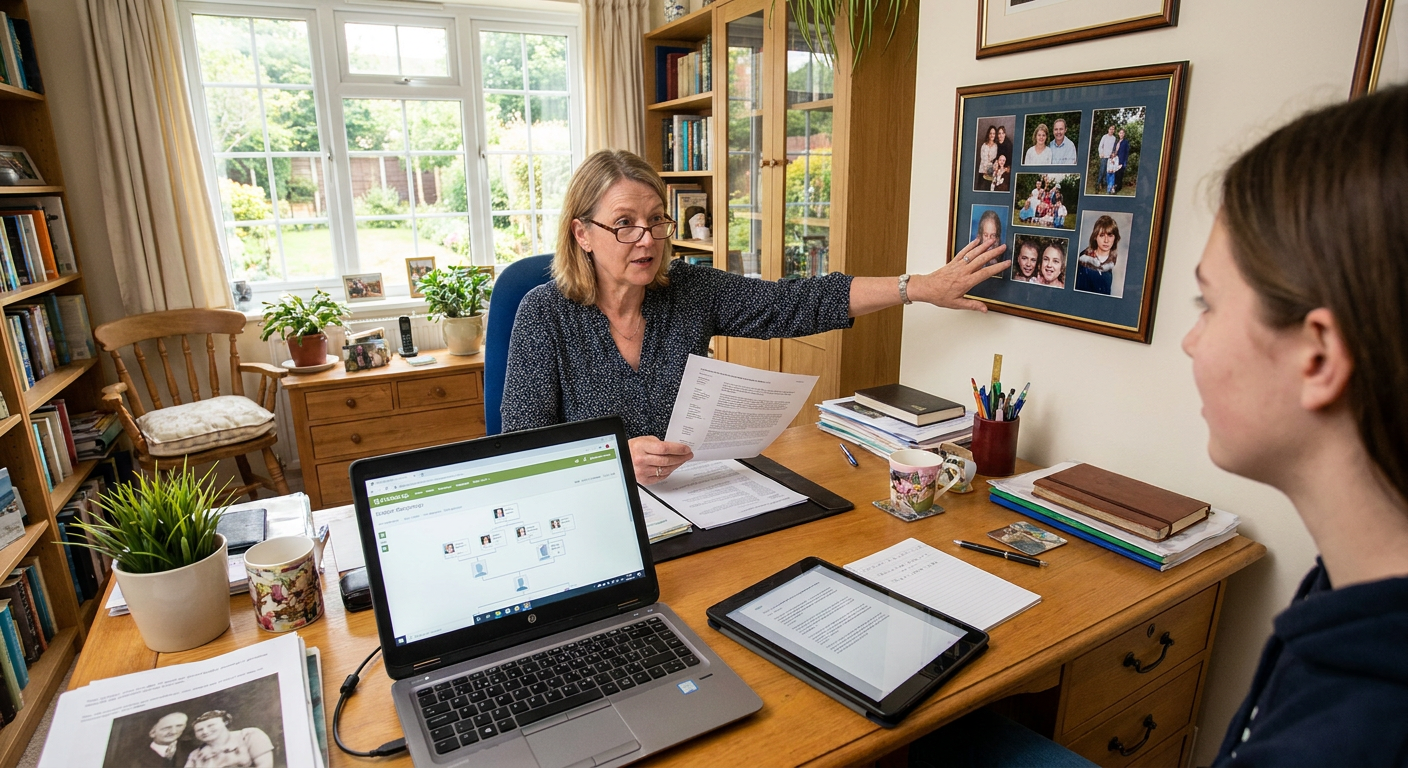
Genealogical research is a complex puzzle, and knowing which piece to look for next can be overwhelming. Knowing which records to search next, what to do when a lead runs cold, or how to interpret a confusing document is a constant challenge. To address this, new AI tools are being developed that act as a personal mentor. These AI assistants function as interactive guides steeped in genealogical methodology, available to provide expert advice around the clock.
From Research Plans to Overcoming Brick Walls
A common stumbling block in family history is the "genealogical brick wall," a point where a researcher can no longer find any new information about an ancestor. These artificial intelligence guides can analyze your existing family tree, identify gaps, and suggest specific, actionable next steps to help break through these barriers. A solid research plan involves evaluating existing evidence and logically determining the next best record to search for. The AI helps automate this process of logical deduction.
For example, it might notice you have a death certificate but no corresponding obituary and suggest searching historical newspaper collections. It can act as a tireless brainstorming partner, suggesting alternative record sets or search strategies that the user may not have considered. Some new chatbots can even search through extensive collections of educational material, such as wikis and instructional blog posts, to provide tailored answers to complex research questions.
Automated Record Analysis and Contradiction Flagging
As you add more historical records to your family tree, the AI can cross-reference the data points. Discrepancy between records are extremely common in genealogy due to clerical errors, name spelling variations, or individuals providing different information at different times in their lives. An AI can systematically scan for these conflicts, which a human might overlook.
For example, if a census record lists a birth year that conflicts with a military draft card, the system will flag the inconsistency. It might present both documents side-by-side and prompt you to review the evidence. This "second set of eyes" helps improve the accuracy and integrity of a family tree by catching errors that can easily be missed during manual data entry, ensuring a more reliable foundation for future discoveries. This systematic review fosters a more critical and evidence-based approach to building a family tree. Researchers often rely on Charts and Forms to manually organize these data points before automation.
From Static Images to Dynamic Stories
Artificial intelligence first made a splash in family history with photo features like colorization and animation. These tools captured the public imagination by providing a novel and deeply personal way to connect with the past. While tools like Deep Nostalgia™ brought a startling sense of life to old portraits, the latest advancements go much further. AI is now used for deep analysis of photographic content, turning a simple image into a rich source of genealogical data.
Identifying Faces and Weaving Narratives
Modern AI can scan a collection of unlabeled family photos and group faces based on biometric data, suggesting the same person may appear in multiple pictures, from childhood to old age. When cross-referenced with your family tree, it might hypothesize the identities of unnamed individuals in a group photo. Some features can even create a draft biography of an ancestor. For instance, the AI Biographer™ feature can take all the photos, documents, and family tree facts associated with an individual like John Keith and weave them into a comprehensive narrative of their life, complete with citations.
Beyond the text, AI can analyze the content of the photos themselves. This involves identifying contextual clues that can provide valuable information. It might identify the uniform in a photo as belonging to a specific military regiment and time period, or date a portrait based on the style of clothing and photographic technology. These visual details add layers of context to an ancestor's life, helping to place them within a specific historical moment and social setting.

Predictive Genealogy and Smart Hypothesis Testing
By analyzing massive datasets of historical records and user-submitted family trees, AI can identify patterns that a human researcher might miss. This is the principle behind technologies like the Theory of Family Relativity™, which suggests plausible relationships by piecing together clues from multiple trees and records. This form of "predictive genealogy" uses probabilistic reasoning to highlight connections that have a high likelihood of being correct, even if no single document proves the link directly.
This ability to see the big picture is where artificial intelligence truly excels. It can process millions of data points simultaneously, far beyond human capacity. A distant a 4th cousin match found through DNA might suddenly become a key connection when AI finds a record linking your two family lines. The AI constructs a potential family tree branch for you to investigate, complete with the supporting evidence it found.
Finding Clues Humans Might Miss
If you have an ancestor who disappears from records in one location and a person with a similar name appears in another, AI can calculate the likelihood that it is the same person. It can do this by analyzing migration patterns from that era, checking for other family members who also made the move, and looking for naming conventions that might connect the two. The system essentially builds a case for or against the connection based on the weight of circumstantial evidence.
This analytical power is especially useful for uncovering subtle clues hidden in plain sight. For example, it might spot that your ancestor’s children’s names match the names of the grandchildren of a family in the new location, suggesting a previously unknown parental link. These are the kinds of complex, multi-step connections that are difficult for humans to formulate but are straightforward for an algorithm designed to find them. Scientists are even developing a new AI model reads DNA sequences to reconstruct ancestry by scanning genomes for biological mutation patterns.
The Ethical Compass: Using AI in Genealogy Responsibly
As artificial intelligence becomes more integrated into genealogy, its responsible use is a topic of paramount importance. This technology handles sensitive personal data and shapes our understanding of identity and heritage. Industry experts and genealogical societies are actively discussing and establishing guidelines to ensure this powerful technology is used ethically and effectively. The goal is not to have AI replace the researcher, but to augment their skills and provide a framework for responsible innovation.
Verification is Non-Negotiable
The most important principle is that AI is an assistant, not an oracle. AI-generated suggestions, whether they are transcribed names or hypothetical family connections, must always be verified against original source documents. AI models can sometimes "hallucinate" or make errors, particularly with ambiguous handwriting or complex relationships. This happens because the AI's goal is to provide a plausible answer, and it may invent details to fill gaps in its knowledge.
Good genealogical practice has always demanded that researchers cite their sources and evaluate evidence critically, and that remains true. Many researchers find that Genetic Ancestry Testing provides a necessary baseline of biological data to cross-reference with these AI-driven findings. The AI can point the way to a record or suggest an interpretation, but the researcher is the one who must perform the actual analysis. The AI can help with these steps, but the final judgment rests with the human historian. This human oversight is essential for maintaining accuracy and intellectual honesty in family history research.
Navigating AI-Generated Narratives and Difficult Pasts
AI is not just uncovering dates and places; it is helping to write life stories. This raises new ethical considerations, especially when the stories uncovered are painful or challenging. An AI might uncover evidence that an ancestor was involved in criminal activity, abandoned a family, or was on the opposite side of a historical conflict than family lore suggests. This can clash dramatically with cherished family traditions. These difficult discoveries are a key part of the Past, Present and Future Perspectives of Forensic Genetics.
When this happens, it is crucial to approach the situation with sensitivity. These discoveries can be jarring, and it is important to remember the real people behind the records. The role of the genealogist is not just to collect facts, but to place them in historical context and understand them with empathy. This is a reminder that while AI provides data, humans provide the empathy and understanding required to interpret that data, especially when you discover your ancestor might not be a hero.
Ultimately, the rise of AI in family history is a story of collaboration. It is about pairing the analytical power of machines with the curiosity, intuition, and empathy of the human researcher. This partnership allows for a deeper and more nuanced exploration of our origins. The result is a more accessible, efficient, and profound way to connect with the past and understand the stories that made us who we are.
Frequently Asked Questions