 English

sit at the intersection of practical research and the slower work of family history. Understanding how the ai that can read your ancestors fit together gives researchers a clearer way to explore questions about earlier generations. The sections that follow walk through what each one offers and how they complement other approaches to family-history research.

Key Takeaways
- Illegible handwriting on historical documents is a major challenge for genealogists, obscuring vital details about family history.
- Modern AI tools can now transcribe, interpret, and even translate handwritten text from old letters, records, and photos.
- This technology goes beyond simple text recognition, providing contextual insights about names, places, and dates found in the document.
- By using AI to analyze difficult-to-read documents, researchers can break through brick walls and add rich new details to their family story.
The End of the Indecipherable Document
Variations in script, faded ink, archaic terms, and damage over time can make reading historical documents a painstaking, often impossible, task. Researchers would spend hours cross-referencing letter shapes or seeking help in online forums to decipher a single confusing word.
Early digital tools offered a limited solution with Optical Character Recognition (OCR), but this technology was designed primarily for printed text. It struggled immensely with the variability of human handwriting, especially historical cursive styles. The result was often a jumble of nonsensical characters, leaving the researcher back at square one. The gap between the handwritten past and the digital present remained wide.
Artificial intelligence is changing this landscape entirely. A new generation of AI-powered tools is designed specifically to tackle this problem. These smart documentation platforms can record, build, and organize written records from various inputs, effectively acting as a personal research assistant. One groundbreaking new feature in this field is Scribe AI.
Announced in early March 2026 at RootsTech, this tool uses advanced artificial intelligence to not just transcribe, but also interpret and provide deep insights into family history documents. Instead of just performing basic text extraction, this technology attempts to understand the document’s meaning and historical context, representing a significant leap forward for genealogists.
How AI Unlocks Your Family’s Handwriting
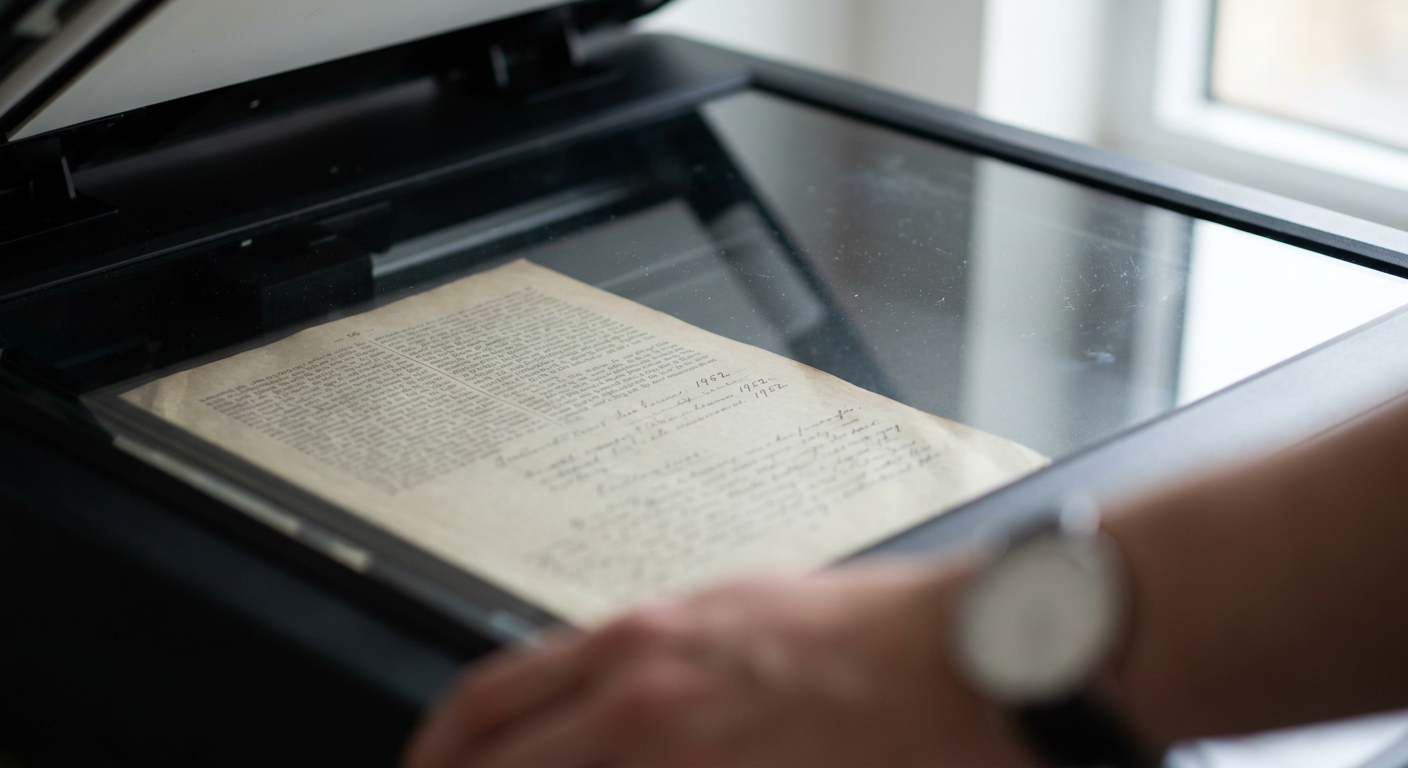
A Scribe AI tool is a sophisticated application of artificial intelligence that utilizes technologies like speech recognition, Natural Language Processing (NLP), and machine learning to automate documentation. For genealogy, the process is remarkably simple: you begin by uploading a digital image of a historical document, whether it’s a full page from a will, a postcard from a distant relative, or a photo with a handwritten caption. The AI then gets to work.
### From Scribbles to Searchable Text
The core function of these AI tools is transcription. The AI is trained on vast datasets of historical handwriting styles to recognize different forms of cursive, script, and print. But it goes further by performing interpretation and abstraction. It doesn’t just give you a block of text; it identifies key entities within the document. It is designed to pinpoint names of people, places, and important dates, extracting them into a structured, easy-to-review report. This is made possible through NLP, which allows the AI to understand grammar and context, helping it distinguish between a person’s name and a place name, even when capitalization is inconsistent.
### Uncovering Deeper Meaning
Beyond simply reading the words, these tools can provide contextual insights. For example, an AI might identify the type of document (e.g., a will, a military record, a personal letter) and provide historical context about what was happening at that time or what certain symbols or archaic terms might mean. This is the “interpretation” that separates modern AI from simple transcription software. For researchers with immigrant ancestors, a built-in translation feature can be invaluable, opening up a world of historical records from your family’s country of origin that were previously inaccessible due to language barriers.
This multi-layered analysis means that a document that was once a genealogical dead end can suddenly become a rich source of new leads, family stories, and verifiable facts for your family tree.
Beyond Transcription: The Power of Contextual Insights
The true revolution of a feature like Scribe AI isn’t just that it can read old handwriting, but that it can help you understand it. It moves a researcher from merely deciphering a document to interpreting its place in an ancestor’s life. This analytical power can surface clues that even a patient human transcriber might overlook.
Imagine uploading a historical document. Instead of just getting a wall of transcribed text, the AI will provide:
- A Full Transcription: The complete text of the document, rendered in easy-to-read digital format.
- An Extracted Entities List: A clean, bulleted list of every person’s name, place name (cities, counties, countries), and date mentioned in the document. This saves hours of re-reading and note-taking.
- Contextual Analysis: The AI may offer insights about the document itself, clarifying legal terms or explaining the relationships implied by the text (e.g., identifying the testator, executor, and beneficiaries in a will).
This ability to deconstruct a document is transformative. A researcher can instantly see all the individuals involved in a land transaction or all the family members mentioned in a letter, making it far easier to connect the dots and build a family tree on a comprehensive platform for researching family history.
Putting AI Document Analysis into Practice
By applying this technology to your own collection of family papers or to documents you find in online archives, you can accelerate your discoveries and add incredible depth to your understanding of your ancestors' lives. Genealogy's biggest headache just got solved by AI, allowing for faster processing of complex records.
### Unlocking Personal Stories
Consider a bundle of old family letters exchanged between your great-grandparents where the handwriting is messy and hard to follow. By running them through an AI scribe, you can get a full, searchable transcription, revealing details of their daily lives, relationships, and the challenges they faced. Suddenly, you might uncover the story of their courtship, their struggles during an economic downturn, or their heartfelt thoughts on a historical event. The same applies to diaries, journals, or recipes with notes in the margins, all of which have long been unreadable.
### Finding Clues in Records and Photos
The technology is equally powerful for official documents and old photographs. You might be struggling to read the occupation of an ancestor in an 1880 census record where the enumerator’s handwriting is a scrawl. An AI transcription can often decipher the word and unlock a new avenue of research. Perhaps a baptismal record contains the names of godparents written in a barely legible script; transcribing them could reveal close family friends or previously unknown relatives. Even better, that blurry name of a witness on a marriage certificate could turn out to be the bride’s married sister, providing her new surname and cracking a brick wall.

Integrating AI Transcriptions into Your Research Workflow
Getting a clean transcription is an exciting breakthrough, but it’s the first step, not the last. This ensures the information you uncover is accurate, properly sourced, and woven into your family story. From chaos to clarity: the research habits of the world's most effective genealogists often involve documenting findings immediately.
### Step 1: Analyze the AI-Generated Report
Once the AI has processed your document, take time to carefully review the entire report. Look at both the full transcription and the list of extracted entities. Are there names or places you didn’t notice on your own? Does the AI
Frequently Asked Questions
