English

You just opened your DNA results, eagerly anticipating a breakdown of a Spanish lineage you've traced for generations. You see the expected notes of the Iberian Peninsula, but then a surprising percentage appears: Eastern European. For some, this unexpected flag from the region of Ukraine can be confusing, sparking questions about family stories and documented history. This scenario is more common than many realize, revealing the deeply interconnected story of human migration.

Far from being a data error, these surprising genetic links are often faint echoes of ancient journeys, complex Diasporas, and the demographic ebbs and flows that have shaped continents over millennia. Understanding these connections opens up new avenues for discovery, transforming a simple percentage on a chart into a rich historical investigation.
Key Takeaways
- Unexpected ethnicity results, like Ukrainian DNA in a Spanish profile, often point to ancient migration patterns or the complex history of Jewish populations across Europe.
- Your ethnicity estimate is a fantastic starting point, but your DNA Matches are the key to confirming ancestral connections. They provide concrete evidence of shared heritage.
- Researching Ukrainian roots can be challenging due to shifting borders and records kept in multiple languages, including Polish, Russian, and German.
- The most effective genealogy strategy combines DNA evidence with traditional historical record research. Use DNA to form hypotheses and documents to prove them.
The Historical Threads Connecting Spain and Ukraine
At first glance, Spain and Ukraine sit on opposite ends of Europe. How could their populations possibly share a significant genetic heritage?
Ancient Migrations: Echoes of the Steppes
One of the most significant historical links involves large-scale migration events. Various tribal groups originating in Eastern Europe moved south and west over many centuries. Some of these groups settled for a time in the vast lands north of the Black Sea, an area that includes modern-day Ukraine.
Later, spurred by pressures from other migrating peoples, these populations again moved westward. Some eventually traveled across Europe to establish influential kingdoms in the Iberian Peninsula. A [migration from Central Europe transformed the genetic profile] of these regions significantly. Their genetic footprint, carried from Eastern Europe, would have blended into the local Iberian population.
While many centuries have passed, these ancient genetic markers can still surface in the DNA of modern-day Spaniards, appearing as segments that match reference populations from Eastern Europe. Ancient DNA shows the genetic imprint of these vast movements across the continent.
The Jewish Diaspora: A Genetic Bridge Across a Continent
Another profound connection lies in the history of the Jewish people. The two largest groups in the Jewish Diaspora are the Ashkenazi Jews, with roots in Central and Eastern Europe, and the Sephardic Jews, from Spain and Portugal. Following their expulsion from Spain, many Sephardic Jews migrated across Europe and the Ottoman Empire. Some found their way to Eastern Europe, where their communities sometimes integrated with existing Ashkenazi populations.
Conversely, migrations also flowed from east to west over the centuries. This intricate web of movement, separation, and occasional intermingling created a shared genetic heritage that can cross the Ashkenazi-Sephardic divide. A person with deep Spanish roots might discover Ashkenazi Jewish heritage from an ancestor who migrated centuries ago, bringing Eastern European DNA along with them. These discoveries can be powerful, helping to science is bridging an 80-year silence for families torn apart by historical events and revealing a multifaceted identity.

From Estimate to Evidence: How to Investigate Your Ukrainian Connection
An ethnicity estimate is a clue, not a conclusion. If you discover an unexpected percentage of Ukrainian DNA, the next step is to put on a detective hat and use genealogical tools to investigate it.
Your DNA Matches Are the Key
The single most important resource you have is your list of DNA Matches. While your ethnicity estimate provides a broad overview, your matches are people who share a quantifiable amount of DNA with you because you share a common ancestor. This provides the proof.
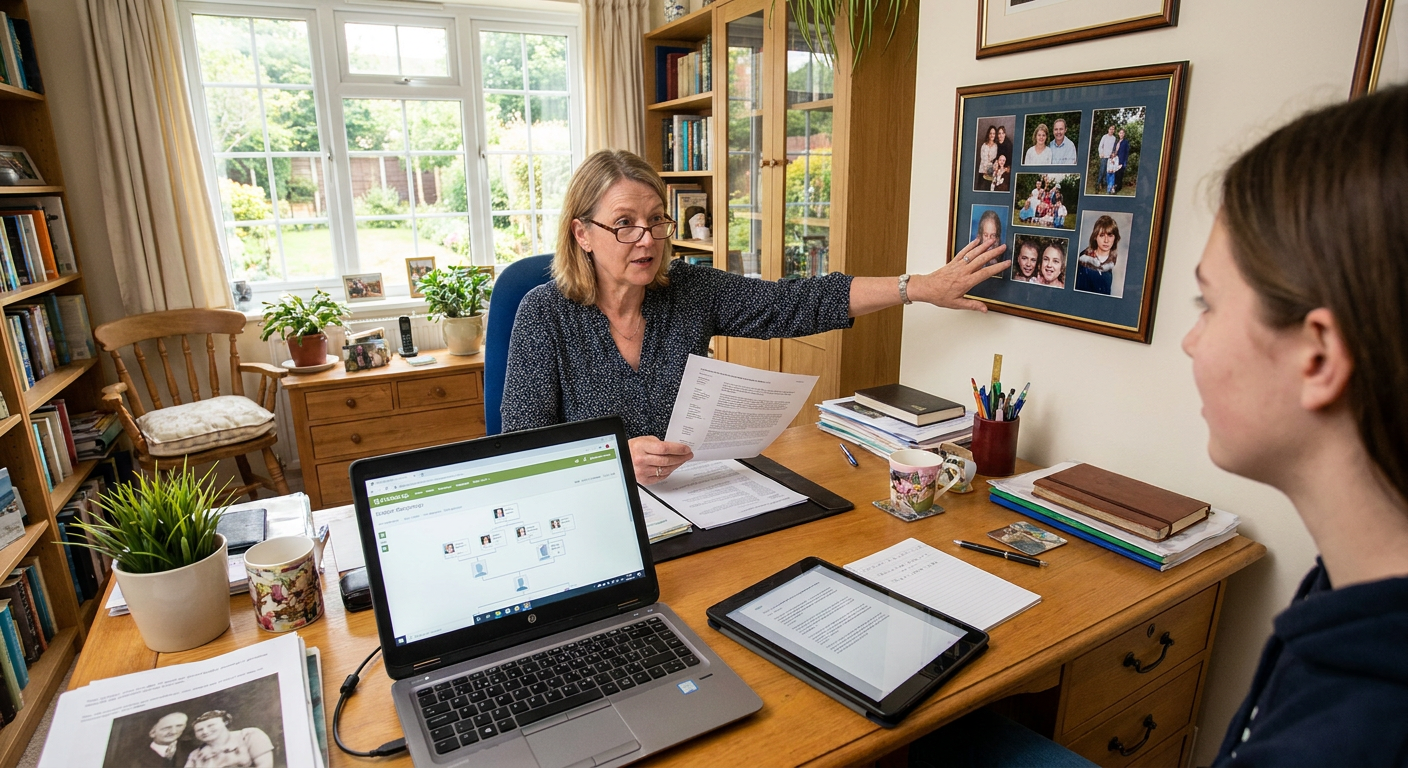
Start by filtering or searching your matches for clues. Look for individuals with known Ukrainian heritage, common Ukrainian surnames in their family trees, or birth locations listed in Ukraine. When you find a promising match, explore their family tree. Look for ancestral couples who lived in the 18th or 19th centuries and see if you can find a corresponding branch in your own tree. Even a 4th cousin match is not a dead end and can provide the vital clue needed to bridge the gap between your known family history and your genetic one.
Diving into the Archives: The Paper Trail
Once a DNA match gives you a potential Ukrainian family line to explore, it is time to turn to historical records. Be prepared for a unique set of challenges. The borders of Ukraine have shifted dramatically over the centuries, with regions being part of the Polish-Lithuanian Commonwealth, the Austro-Hungarian Empire, and the Russian Empire. Consequently, historical records from a single town might be written in several different languages.
Utilizing language guides and gazetteers (geographical dictionaries) is essential to pinpointing an ancestor's specific town and understanding what records might exist. You may need to search historical records in Polish, German, Russian, or Hungarian archives to find birth, marriage, and death records for your Ukrainian relatives. While challenging, successfully navigating these archives provides the concrete documentation that confirms your genetic discovery.
A Tale of Two Strategies: DNA vs. Documents
Each has its own strengths and weaknesses when tackling a puzzle like an unexpected ethnicity result.
The DNA-First Approach
Starting with DNA allows you to leap over brick walls that have stood for decades. It works backward from the present, using your genetics to find living relatives and their documented family trees. It is particularly powerful for those seeking answers in adoption mysteries or for lineages where the paper trail runs cold.
- Pros: Can reveal connections never before imagined. Can indicate specific geographic regions and surnames for further research. Bypasses damaged or lost historical records.
- Cons: Dependent on the number of people from a region of interest who have taken a DNA test. Ethnicity estimates are approximations and can be confusing without the context of matches.
The Paper-Trail-First Approach
This is the classic method of genealogy: starting with what you know and working backward one document at a time. While powerful, this method relies entirely on the survival and accessibility of records. Even a common surname like Maria Hernandez can present challenges when records are missing.
- Pros: Provides definitive proof of names, dates, and relationships. Creates a rich narrative grounded in historical context.
- Cons: Can be completely halted by record loss due to fires, floods, or conflict. Research in foreign archives can present significant language and logistical barriers.

The Hybrid Strategy: The Best of Both Worlds
Ultimately, the most successful approach is a hybrid one. The strengths of one method perfectly compensate for the weaknesses of the other. Use your surprising ethnicity estimate as the starting hypothesis. Use your DNA matches to identify a potential family line or location where that heritage might have entered your tree. Then, use that information to conduct targeted searches in collections of historical records.
This integrated approach transforms genealogy, making it possible to unravel secrets hidden for generations. This is the very technique used to bring answers to families of Holocaust survivors and even help crack cold cases that were once thought unsolvable.
Finding a New Dimension of Self
Discovering an unexpected ethnicity does more than just add a new country to your family tree. It can reshape your sense of self and connect you to a culture, a history, and a people you never knew were part of your story. Scientists looking at genome diversity in Ukraine have highlighted how varied this heritage can be. Learning about one's roots via genetic testing fosters an understanding that individuals are multifaceted.
You can begin to explore the music, food, art, and traditions of that heritage. You might even visit cultural institutions like the Ukrainian Museum-Archives, one of the largest in North America, to connect with the artifacts of your newfound past.
These discoveries are a powerful reminder that history is not something that happens to other people. It lives within our DNA. The journeys, struggles, and triumphs of countless ancestors from across the globe converge to make us who we are. An unexpected result is not an error, but an invitation to uncover another chapter in your unique human story.
Frequently Asked Questions