English
For centuries, the Shroud of Turin has been an object of intense fascination and debate. This long linen cloth, bearing the faint, mysterious image of a crucified man, has been venerated by millions as the authentic burial cloth of Jesus of Nazareth, while skeptics have argued it is a masterful medieval forgery. Now, modern genetic science is adding a new, complex layer to its story. By analyzing fragments of plant and human DNA collected from the cloth, researchers are piecing together a "biography" of the Shroud, tracing its incredible journey through time and across continents.

Key Takeaways
- A Multinational History: DNA evidence extracted from the Shroud of Turin reveals genetic material from numerous plants and people, indicating a long history of travel and handling across Europe, the Middle East, and even India. These microscopic biological traces serve as witnesses to its long and varied past.
- Geographic Fingerprints: Pollen and plant DNA found on the cloth correspond to species native to the Mediterranean and Near East, supporting theories that the Shroud originated in that region and traveled westward. Because many plants are unique to specific climates and soils, their genetic signatures act as reliable markers of geographic origin.
- A Mosaic of Handlers: Human DNA analysis shows contributions from many individuals, creating a "diverse mosaic of genetic traces" that reflects its journey through different populations over centuries. Over time, each person who touched the cloth left a small part of their own genetic story, which became layered onto the fabric.
- The Authenticity Question Remains: While DNA analysis illuminates the Shroud's historical path, it cannot confirm its age or its authenticity as a 1st-century artifact. Scientific debate continues, with different dating methods yielding conflicting results, highlighting the inherent challenges of studying ancient and revered objects.
A Journey Written in DNA
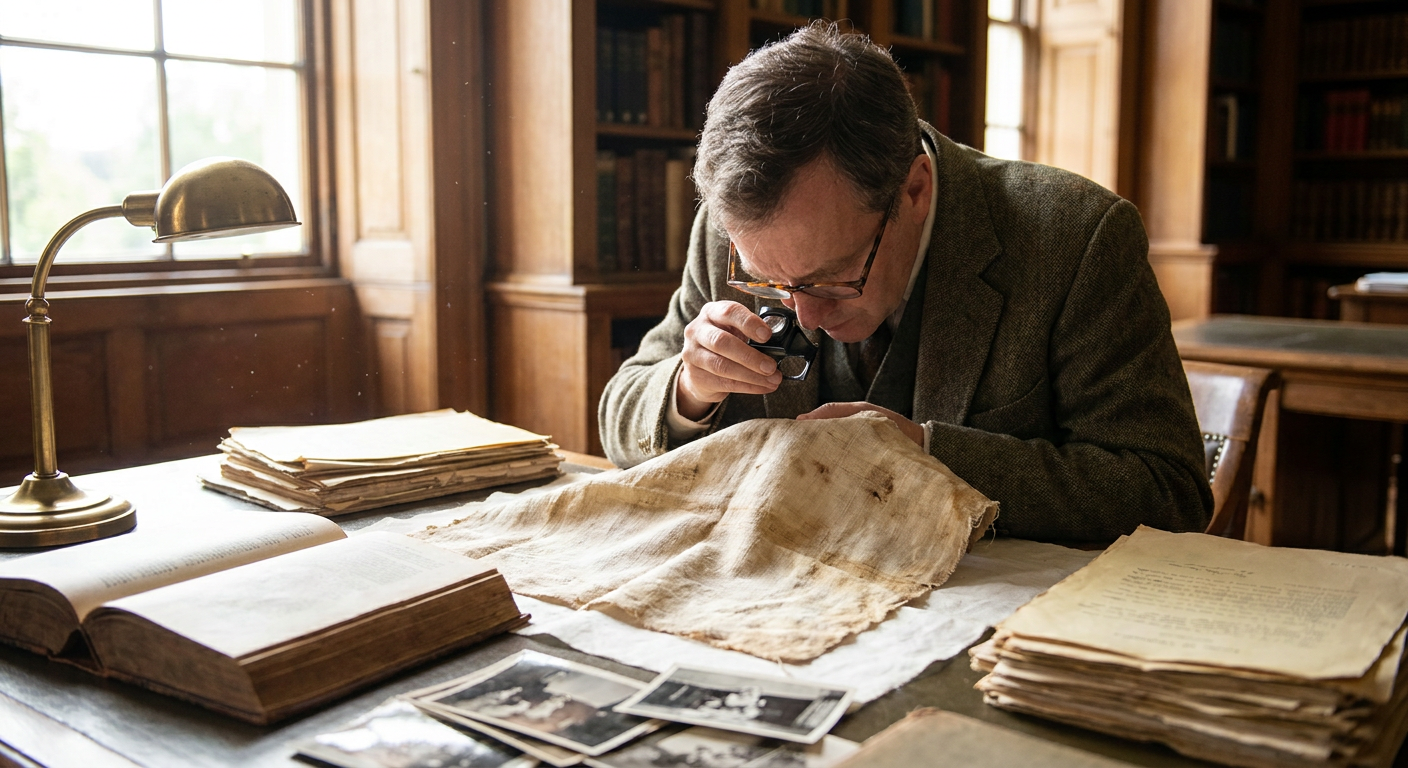
The scientific investigation into the Shroud's past took a significant step forward with the analysis of dust and debris vacuumed from the surface of the linen. This material contained microscopic traces of the world the Shroud has moved through, including pollen grains, plant fragments, and human skin cells. A team of Italian researchers utilized advanced genomic sequencing to analyze the mitochondrial DNA from these tiny samples, effectively creating a genetic logbook of its history. This type of DNA is often more robust than nuclear DNA, surviving for longer periods and making it ideal for examining ancient material.
This process is similar in principle to how genetic genealogy works for individuals. By examining specific DNA markers, scientists can identify the geographic origins of the people and plants that came into contact with the cloth. The findings paint a picture of an object that has been handled, revered, and transported across vast distances. The study identified a "diverse mosaic of genetic traces," transforming our understanding of the Shroud from a static relic into a well-traveled historical artifact. The investigation reveals that, like a family’s biological history, the story of an object can be far more complex and widespread than previously imagined.
The Plant Clues: A Botanical Map
Perhaps some of the most compelling evidence comes from the non-human DNA. Researchers identified genetic material from a wide array of plant species. The distribution of these plants acts as a kind of botanical fingerprint, pointing to the environments the Shroud has been in. Finding DNA from flax, the plant used to create the linen itself, was expected. However, the presence of many other species tells a richer story.
This wealth of botanical data provides powerful clues about the object's journey. Pollen, for example, is incredibly resilient and its distinctive shapes can often be linked to specific plant families that are native to particular parts of the world. The presence of DNA from multiple species endemic to the Mediterranean basin suggests a prolonged presence in that area. This botanical data helps corroborate historical theories about the Shroud's potential origins and its journey westward, adding a layer of scientific evidence to previously speculative paths. Other European plant DNA markers, consistent with its known history in France and Italy, create a chronological sequence of its travels.

The Human Story: A Global Narrative on a Single Cloth
Alongside the plant data, the analysis of human DNA revealed an even more complex story. The linen contains genetic markers from a multitude of people. This isn't surprising for an object that has been publicly displayed and handled by countless individuals over hundreds of years. The simple act of touching, breathing on, or weeping over the cloth would be enough to transfer skin cells and other biological traces.
However, the geographic diversity of this DNA is remarkable. It tells a human story of devotion, travel, and stewardship across cultures and epochs.
Researchers identified mitochondrial DNA haplogroups with origins across Western Europe, North Africa, the Middle East, and as far east as India. These haplogroups and autosomal data are broad genetic populations that trace back to different geographic areas in the deep past. The European DNA, particularly from haplogroups common in France and Italy, likely represents the many people who have cared for or venerated the Shroud since its arrival and documentation in Europe. The traces from the Middle East and India, however, point to a much earlier history and a path that follows ancient trade routes.
Each person who touched the cloth left an invisible trace, and with modern technology, we can now read that story. This exploration into deep ancestral origins is at the heart of how autosomal DNA testing helps people today uncover their own complete family story, connecting them to the broader sweep of human history.
The Ongoing Scientific Dialogue
The various scientific studies of the Shroud of Turin have created a fascinating and sometimes contentious dialogue about its origins. The complexity of the evidence ensures that the mystery is far from solved, with different methodologies yielding seemingly contradictory conclusions. This is not unusual when examining ancient artifacts, where centuries of contamination and degradation can make definitive analysis exceedingly difficult. In truth, this debate is a sign of a healthy and functioning scientific process, which relies on constant re-evaluation and the questioning of established conclusions.
The most well-known controversy surrounds the Shroud’s age. The results famously dated the linen to the medieval period, between 1260 and 1390 AD, which led many to conclude the Shroud was a clever forgery from that era. For many observers, these findings appeared to resolve a centuries-old question with modern, objective certainty. For decades, this was considered by many to be the final word on the matter.
However, the debate was far from over. More recent analysis has questioned the validity of that original sample, with some scientists suggesting the piece tested came from a repair patch made in the medieval period, rather than the original cloth. This highlights a core challenge in historical science: ensuring the sample is representative of the whole. If a sample is taken from an area that was repaired or contaminated, the test results may be perfectly accurate for that sample but entirely misleading about the object in its entirety. This scientific back-and-forth often debunks common myths about the certainty of testing, showing that context is everything.
Further complicating the timeline, other scientific dating methods have been applied to the Shroud. One such method involves analyzing the chemical degradation of the linen fibers themselves over time. Researchers compared this degradation to an ancient linen sample known from historical records to date from 55–74 CE. By establishing a baseline for how linen from a specific era degrades, they could then assess whether the Shroud's chemical makeup was consistent with a much older origin. This approach offers a different kind of clock, independent of other dating methods, but it comes with its own set of variables and scientific debates.
What DNA Can and Cannot Reveal
While this genetic mapping is a monumental achievement, it is essential to understand its limitations. The DNA evidence further complicates the debate over the Shroud of Turin, as it can tell us where the cloth has been, but it cannot definitively tell us how old it is or confirm the identity of the man imaged on the cloth. Genetic material does not have an intrinsic timestamp; its presence only indicates contact with a person or plant at some unknown point in the past. Therefore, the presence of Middle Eastern DNA is not proof of its connection to a specific historical figure from the 1st century, only that it came into contact with people from that region at some point in its long history.
Furthermore, the DNA is a collection from centuries of handling. It represents a "diverse mosaic" of individuals, and it is scientifically impossible to isolate a single, "original" set of DNA from the overwhelming background noise of subsequent handlers. Think of it as trying to listen to a single whisper from centuries ago in a room that has been filled with conversation ever since. The genetic information speaks to the Shroud's complex life as a historical object, rather than to its moment of origin.
Ultimately, the DNA analysis enriches the story of the Shroud of Turin without resolving its central mysteries. It transforms the cloth from a single, static mystery into a dynamic one, revealing a long and storied past written in the language of life itself. The journey of the Shroud continues, not only as a religious relic but as a fascinating scientific puzzle that still invites new questions and new methods of investigation.
Frequently Asked Questions