English
Genetic genealogy has opened up breathtaking new avenues for exploring family history, connecting people with their heritage and previously unknown relatives. With just a simple saliva sample, a DNA test offers a fascinating window into the past. However, as this science has grown in popularity, so have the myths and misconceptions surrounding it. These misunderstandings can lead to confusion and incorrect conclusions about one's lineage. Separating scientific fact from fiction is essential for anyone looking to accurately uncover their family story.

This article will explore seven common myths about genetic genealogy and reveal why science tells a different story. By approaching DNA results with a clear view of their power and their limitations, you can unlock a richer, more authentic connection to your ancestors.
Key Takeaways
- Genetic genealogy is a powerful supplement to, not a replacement for, traditional family history research using historical records.
- Ethnicity estimates are scientific approximations based on reference populations and can evolve as science advances; they are not an exact readout of your family tree.
- DNA inheritance is random, meaning you will not inherit DNA from every single one of your distant ancestors.
- Family legends and oral traditions are valuable clues, but they should always be verified with independent sources.
1. Myth: A DNA Test Will Tell You Everything About Your Family
A common belief is that a single DNA test acts as a magic wand, conjuring a complete family tree out of thin air. The reality is that while DNA is a revolutionary component of genealogical research, it is only one piece of a much larger puzzle. Genetic analysis provides clues, not a complete narrative.
These genetic clues point toward relationships and origins, but they lack the essential context that forms a family history. A DNA test can suggest you are related to another person, but it cannot explain the nature of that relationship. It requires traditional research to discover if you share a set of great-grandparents or a more distant ancestral couple who lived centuries ago.
DNA is a Clue, Not the Whole Story
Your results are the starting point for an investigation, not the final answer. An ethnicity estimate might tell you that you have heritage from a certain region, but it won't name the specific 5th-great-grandparent who brought that heritage into your family line. Similarly, a DNA match to a cousin is a lead, not a conclusion. This means building a family tree and hunting for historical records to provide the names, dates, relationships, and context that give life to the raw data in your DNA.
2. Myth: Ethnicity Estimates Are 100% Definitive and Unchanging
Receiving an Ethnicity Estimate can be one of the most exciting parts of the DNA testing experience. Because these reports are presented with scientific confidence, many assume they are absolute and final. However, ethnicity estimates are interpretations of your DNA based on comparing it to the DNA of people with deep roots in specific regions, known as reference populations.
This process is fundamentally a statistical one. An ethnicity estimate is an educated guess based on probabilities, not a simple reading of your ancestry. The science involves finding segments of your DNA that most closely match the patterns found within these established reference groups. Because human populations have mixed and migrated for millennia, many of [these patterns] are not unique to a single location, which adds layers of complexity to the analysis.
Why Estimates Evolve
The algorithms that calculate these estimates are constantly being improved, and the reference panels are regularly updated. As testing companies gather more data from more people around the world, they can create larger and more diverse reference panels. This allows for a more granular and accurate understanding of genetic patterns, which in turn refines the calculations.
When an update occurs, your percentages might shift. This doesn't mean your previous results were "wrong," but rather that the scientific lens has become more refined. Human history is one of migration, and populations have never been entirely static, leading to overlapping genetic patterns that make precise distinctions a complex statistical challenge.
3. Myth: You Inherit DNA from All Your Ancestors
It seems logical that if someone is on your family tree, you must have some of their DNA. While you inherit DNA from your parents, who inherited it from theirs, the genetic thread does not extend back indefinitely in a predictable way. Due to the random nature of genetic recombination, after just a few generations, you will have ancestors from whom you inherited no DNA at all.
This process of inheritance can be imagined like shuffling multiple decks of cards. Each parent passes on a random half of their own genetic deck to their child. As you trace the lineage back, the number of ancestors doubles with each generation, but the amount of DNA you receive from each of them is not perfectly divided. Eventually, some ancestors get completely shuffled out of the deck that is passed down to you.
The Math of Genetic Inheritance
The further back you go, the more this randomness adds up. While you get about twenty-five percent of your DNA from each grandparent, the amount from each great-grandparent is only an average of twelve and a half percent. By the time you get to your 5th-great-grandparents, you have 128 ancestors at that level. Statistically, it is likely you did not inherit any DNA from some of them. You are still their direct descendant, but their genetic contribution to you has been diluted to zero.
4. Myth: Family Stories and Oral Histories Are Always Accurate
Family lore often speaks of a famous ancestor or a dramatic name change at a port of entry. These treasured stories that are passed down through generations form a core part of a family's identity. While these tales are invaluable as clues and starting points, they should never be accepted as literal truth without verification.
Even when not factually precise, these narratives hold immense value. They can preserve the emotional truth of a family's experience, their values, and their sense of self. A story of a long journey to a new land might encapsulate generations of hope and hardship, even if specific details have changed. Approaching these stories with respect for their cultural importance is just as crucial as verifying their details.
Verifying Family Legends
Over time, stories can be embellished, and misunderstandings can become cemented as fact. The process of transmitting stories orally from one generation to the next naturally introduces small changes that can accumulate over time. A modest family farm might transform into a sprawling estate in the retelling, or the reason for a migration might be simplified for dramatic effect.
Use the names, places, and events mentioned in the story as keywords for searching through historical records. Verification is not about proving a story "wrong" but about enriching it with a documented foundation. You may find that the core of the story is true, even if the details have shifted, or discover an equally interesting truth about your family's past.
5. Myth: A Shared Surname Guarantees a Genetic Relationship
Finding someone with the same last name can feel like an instant connection, especially if it's an uncommon one. This leads many researchers to assume that all people sharing a surname must descend from a common ancestor. While this can be true, it's a risky assumption that can lead research in the wrong direction.
Independent Origins of Surnames
Surnames have multiple, independent origins, and in many cultures were adopted for administrative or social reasons. They can be patronymic (based on a father's name), occupational (Smith, Cooper), or locational (Hill, Ford). Others might derive from a personal characteristic or an affiliation with a powerful local family. This means the same surname could arise in different families with no genetic connection whatsoever.
Just because your last name is Worthington does not automatically connect you to every other Worthington in the world. Furthermore, events like informal adoption, name changes for social or personal reasons, and other family complexities can separate a surname from a direct genetic line. The only way to prove a connection is to build out your respective family trees with documentation until you find a shared ancestor.
6. Myth: Genetic Genealogy Makes Traditional Research Obsolete
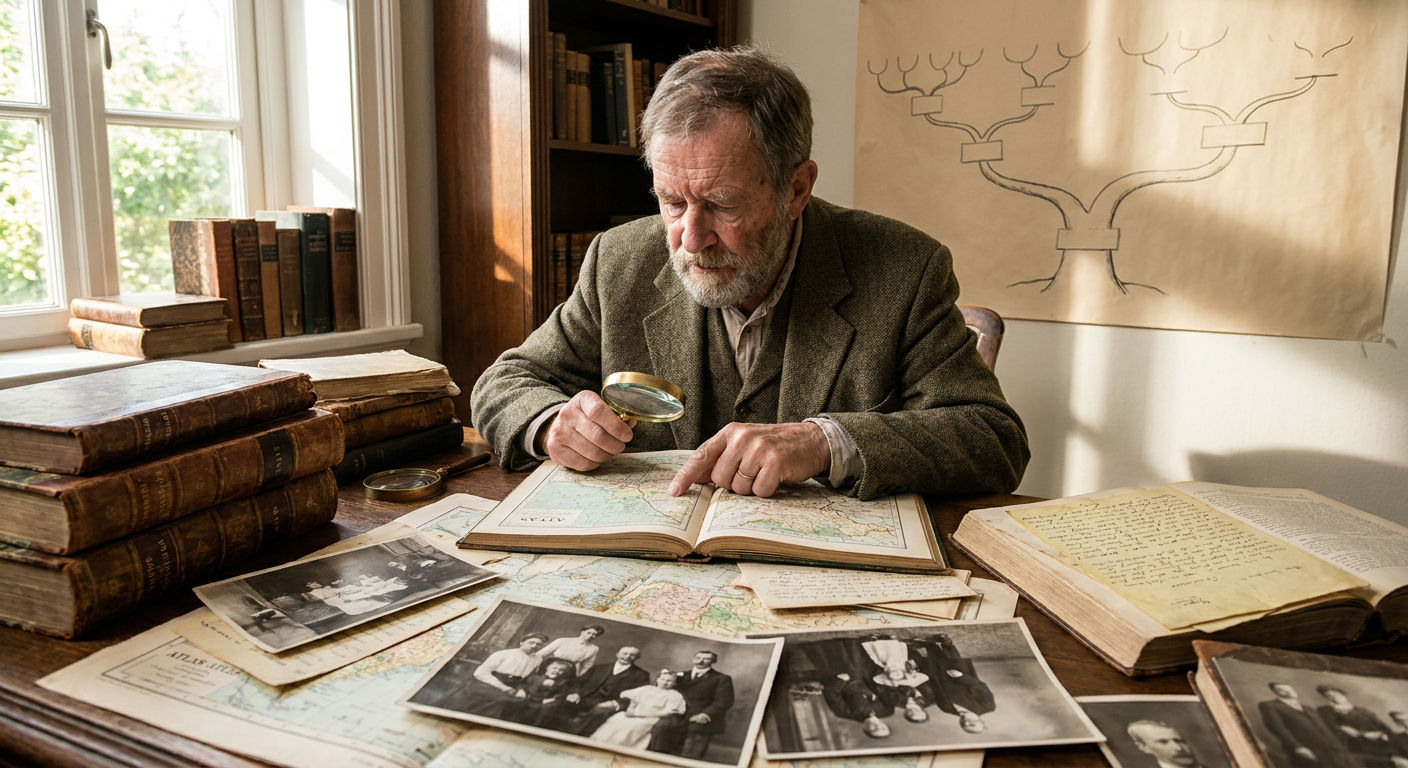
This couldn't be further from the truth. Genetic genealogy and traditional research are not competing methods; they are complementary partners. Each provides a type of information that the other cannot. Believing that a DNA test can replace archival research is like trying to build a house with only a blueprint and no materials.
DNA excels at suggesting relationships and breaking through brick walls where historical records are missing or ambiguous. For instance, a strong DNA match to a stranger might be the key to identifying an ancestor who was not well-documented. However, that is where the role of DNA ends and the work of a genealogist begins. To turn that DNA match into a known relative, you must research both family trees, find the common ancestor, and document the lineage with primary source records like birth, marriage, and death certificates.
A Powerful Partnership
Conversely, traditional research provides the framework and context that gives DNA results meaning. Without a family tree, a DNA match is just a name on a screen. Together, the two methods create a powerful synergy that can lead to discoveries impossible with either approach alone.
7. Myth: All DNA Tests and Companies Are Created Equal
While many companies offer ancestry testing, the technology, the size of their databases, and the tools they provide can vary significantly. Choosing where to test is an important decision that can have a major impact on your research. The two key factors that differentiate these services are the size of their DNA database and the analytical features they offer.
A larger database means a higher probability of finding meaningful DNA matches with relatives who have also tested. The unique tools and features each company provides can also dramatically alter your ability to interpret your results and make new discoveries about your family history. The right combination of a deep database and powerful analytics is what makes truly remarkable family connections possible.
By understanding these common myths, you are better equipped to navigate the exciting world of genetic genealogy. Embracing both the science and its limitations is the key to a more accurate and rewarding journey of discovery into your past.
Frequently Asked Questions